

ROHM CMOS Op Amps have officially launched, bringing a new level of precision, speed, and design flexibility to the global electronics market. ROHM Co., Ltd. has proudly expanded its analog semiconductor lineup with the introduction of 17 new high-performance operational amplifiers, specifically categorized under the highly anticipated “TLRx728” and “BD728x” series. Designed to meet the rigorous demands of modern electrical engineering, these new components are exceptionally suited for a wide array of applications, spanning automotive EV systems, heavy industrial equipment, and advanced consumer electronics. By offering such a broad and versatile product lineup, ROHM is making the component selection process significantly easier and more efficient for hardware developers worldwide.
The Surging Demand for High-Accuracy Operational Amplifiers
In recent years, the global technology sector has witnessed a massive and rapid increase in the demand for high-accuracy operational amplifiers. As modern automotive systems—such as electric vehicle (EV) battery management, electronic power steering, and advanced driver-assistance systems (ADAS)—become increasingly sophisticated, they require internal components that can deliver faster processing speeds, tighter precision, and higher overall energy efficiency.
Similarly, industrial robotics and factory automation systems rely heavily on precise, real-time sensor data. In any electronic application that requires the amplification of minute sensor outputs, minimizing signal error and processing delay is absolutely critical. Because sensor outputs are often just a few millivolts, if an op amp introduces even a tiny voltage error, that error is amplified exponentially alongside the actual signal. To successfully meet these stringent operational requirements, a well-balanced set of key characteristics is mandatory. Engineers are constantly seeking the perfect, elusive combination of low Input Offset Voltage, minimal internal Noise, and a rapid Slew Rate.
Exceptional Performance: Low Offset, Low Noise, and High Slew Rate
The newly launched ROHM CMOS Op Amps are high-performance devices purposely engineered to excel in these exact areas. They simultaneously achieve a low input offset voltage, ultra-low noise levels, and an impressively high slew rate—a technical combination that is notoriously difficult to balance in traditional analog circuit design.
- TLRx728 Series: This premium lineup features a remarkably low input offset voltage of just 150 μV (typical). This makes it the ideal choice for hyper-sensitive precision applications where even the slightest voltage discrepancy could compromise system reliability and safety.
- BD728x Series: Serving as a highly robust and versatile option, this series offers a highly competitive input offset voltage of 1.6 mV (typical), making it perfect for general-purpose, high-performance needs across various circuit boards.
Both of these operational amplifier series boast an incredibly low noise voltage density of just 12 nV/√Hz at 1kHz, ensuring that thermal noise and electrical interference are kept to an absolute minimum. Furthermore, they feature a high slew rate of 10 V/μs. This means the amplifiers can rapidly respond to fast-changing input signals without causing waveform distortion or clipping. As a result, they are perfectly suited for precision tasks like intricate sensor signal processing, microcurrent detection circuits, advanced motor driver control, and critical power supply monitoring systems.
Enhancing Design Flexibility with Rail-to-Rail Capability
Another massive architectural advantage of these new products is their Rail-to-Rail input and output capability. Traditional operational amplifiers often struggle to utilize the full span of their power supply, leading to a narrower usable voltage range. However, the Rail-to-Rail design in the new ROHM CMOS Op Amps allows for maximum utilization of the power supply voltage range. This ensures a significantly wider dynamic range, helping to maintain strict processing accuracy even in low-voltage automotive or wearable IoT designs.
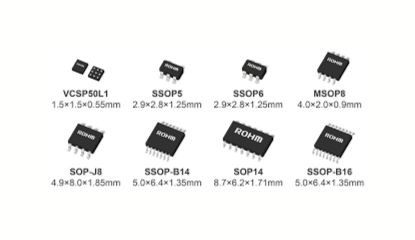
Furthermore, to accommodate a massive variety of circuit board sizes and integration complexities, ROHM is offering these new components in 1-channel, 2-channel, and 4-channel configurations. Coupled with a diverse range of packaging options, hardware developers can make the optimal product selection based precisely on their physical space constraints and thermal dissipation requirements.
Global Pricing and Availability
The new series of operational amplifiers are being released simultaneously to the global market, with only a few specific automotive-qualified part numbers pending full mass production. Sample pricing is highly competitive and accessible for immediate prototyping:
- 1-Channel Configurations: $2.00 per unit (excluding tax)
- 2-Channel Configurations: $2.80 per unit (excluding tax)
- 4-Channel Configurations: $4.00 per unit (excluding tax)
For detailed technical specifications, pinout diagrams, and sales information, engineers can refer to ROHM’s official lineup table. These highly anticipated components are also available for immediate online purchase through authorized global electronics distributors, including DigiKey, Mouser, and Farnell.
Understanding Key Op Amp Terminology
For those integrating these new analog components, understanding a few core metrics is vital for maximizing circuit performance:
- Input Offset Voltage: This is the small error voltage that naturally generates between the two input terminals of the operational amplifier. It is the specific voltage that must be applied to force the output to exactly zero volts.
- Slew Rate: A critical performance metric indicating exactly how rapidly an op amp’s output voltage can change per unit of time while operating within its linear region.
- Noise Voltage Density: Also known as noise spectral density, this measures the noise power per square root of a 1 Hz bandwidth.
Follow aarokatech.com for more updates.