

Mitsubishi Electric power semiconductor data service is officially launching on June 28, 2026, marking a massive shift in how engineers design power conversion systems (PCSs). Announced by Mitsubishi Electric Corporation (TOKYO: 6503), this free initiative provides comprehensive design and validation data for a proprietary prototype inverter equipped with the company’s latest 8th-generation Insulated Gate Bipolar Transistor (IGBT) modules. By eliminating the traditional, time-consuming hurdles of parts selection and physical prototyping, the service directly addresses the engineering bottlenecks in manufacturing large-capacity solar and renewable energy inverters.
As global infrastructure rapidly shifts toward megawatt-class renewable energy power generation, the demand for highly efficient Power Conversion Systems has skyrocketed. However, deploying next-generation power semiconductors into complex three-level inverter topologies frequently introduces massive technical challenges, including intricate thermal management, fault protection, and high-density geometric layouts. Mitsubishi Electric’s new data-provision service is engineered to solve these exact friction points.
The Core Challenge: Why Inverter Prototyping Traps Engineering Teams
Developing high-voltage, large-capacity PCSs for mega-solar plants or wind farms requires absolute precision. Standard development workflows typically suffer from a repetitive, costly loop:
- Parts Selection: Guessing initial compatibility metrics.
- Prototype Design: Drafting complex layout geometries without real-world reference baselines.
- Performance Evaluation: Discovering thermal hot spots or surge voltage failures late in the cycle.
- Reliability Testing: Redesigning and re-manufacturing physical prototypes multiple times.
This traditional cycle delays time-to-market. By utilizing the new Mitsubishi Electric power semiconductor data service, engineering teams can bypass initial trial-and-error phases by leveraging verified, real-world baseline data.
Inside the Service: Comprehensive Design and Validation Datasets
The complimentary service delivers exhaustive, production-grade datasets for two primary semiconductor modules tailored for medium- to large-capacity systems:
1. Industrial LV100-type 1.2kV IGBT Module
- Target Application: Large-capacity Power Conversion Systems (PCS) for utility-scale solar arrays.
- Module Rating: 1200V / 1800A (Model: CM1800DW-24ME).
- Inverter Capacity: 1.2 Megawatt (MW) capacity systems.
2. Industrial NX-type 1.2kV IGBT Module
- Target Application: Medium- to large-capacity industrial power systems.
- Module Rating: 1200V / 1000A (Model: CM1000DX4-24ME).
- Inverter Capacity: 0.8 Megawatt (MW) capacity systems.
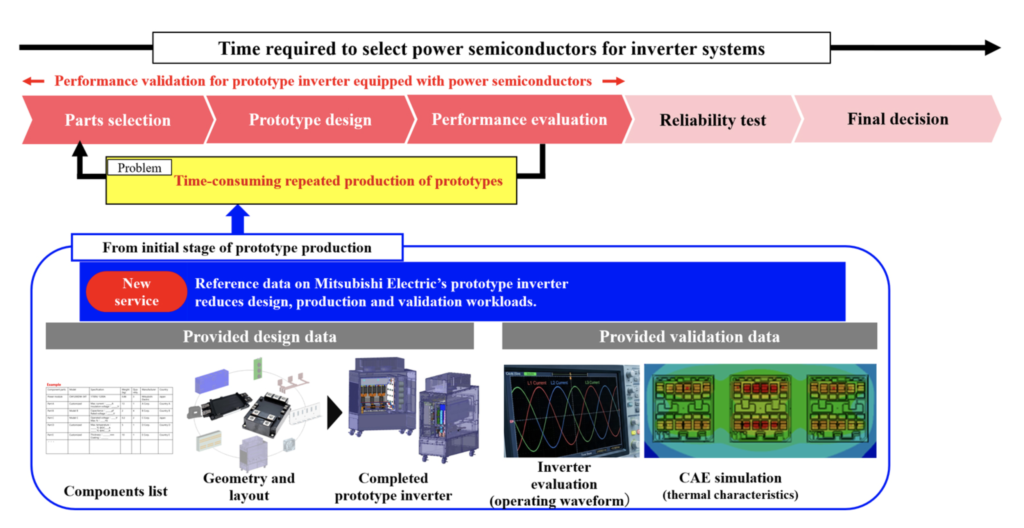
Provided Design Assets
Subscribers receive complete Computer-Aided Design (CAD) files, accurate bills of materials (BOM), physical geometry specifications, and precise electrical circuitry mapping. This allows developers to integrate the module layouts directly into their system schematics.
Provided Validation Assets
Beyond physical blueprints, the dataset includes rigorous testing metrics derived from physical equipment evaluations. Engineers gain access to actual operating waveforms, short-circuit protection limits, current balance analysis, and Computer-Aided Engineering (CAE) thermal characteristic simulations.
Technical Synergy: Collaboration with ITRI Taiwan
To ensure the provided data meets strict real-world engineering standards, Mitsubishi Electric collaborated extensively with the Industrial Technology Research Institute (ITRI) in Taiwan. ITRI’s deep expertise in advanced power conversion technologies allowed the joint team to construct highly optimized peripheral components, complex control systems, and rigorous reactor load testing environments.
The resulting datasets reflect highly reliable, practical validation metrics. By comparing internal prototype designs against these pre-validated operating waveforms and thermal profiles, engineering teams can drastically minimize manufacturing errors and hit internal compliance targets on their very first build.
Prototype Inverter Engineering Specifications
The provided data covers advanced 3-level Active Neutral-Point Clamped (ANPC) three-phase inverter topologies operating under high-voltage conditions:
| Parameter | LV100-type Prototype | NX-type Prototype |
| Semiconductor Technology | 8th-Gen IGBT Module | 8th-Gen IGBT Module |
| Topology Type | 3-level ANPC Three-Phase | 3-level ANPC Three-Phase |
| System Capacity | 1.2 MW | 0.8 MW |
| DC Input Voltage | DC 1500V | DC 1500V |
| AC Output Voltage | AC 660V | AC 660V |
| Maximum Rated Current | AC 1050A | AC 700A |
| Isolation Rating | 4kV Isolation | 4kV Isolation |
Driving Global Decarbonization and System Efficiency
Three-level inverter architectures provide significant advantages over traditional two-level systems. By generating an intermediate potential to control output voltage in three distinct levels, they achieve much higher power conversion efficiency and allow for more compact, material-saving equipment designs.
By offering this design and validation data completely free of charge, Mitsubishi Electric is effectively removing the steep technical barriers that typically slow down green energy startups and industrial manufacturers. This open-data approach will accelerate the global rollout of high-efficiency renewable energy infrastructures, paving a faster path toward global net-zero goals.
Follow us to get the latest updates on aarokatech.com