
LiDAR sensor technology has emerged as one of the most transformative innovations of the 21st century, fundamentally reshaping how machines perceive and interact with the physical world. From autonomous vehicles navigating complex urban environments to drones mapping vast agricultural landscapes, LiDAR sensors are becoming the eyes of intelligent systems. As we progress through 2026, this technology continues to evolve at a breathtaking pace, offering unprecedented accuracy, range, and affordability that is making it accessible across diverse industrial applications.
The global LiDAR market is experiencing exponential growth, projected to reach $16.7 billion by 2030, driven by increasing adoption in automotive, robotics, smart city infrastructure, and environmental monitoring sectors. Industry leaders are recognizing that LiDAR sensors are no longer just a futuristic concept but a critical component for competitive advantage in an increasingly automated world.
Understanding LiDAR Sensor Technology: How It Works
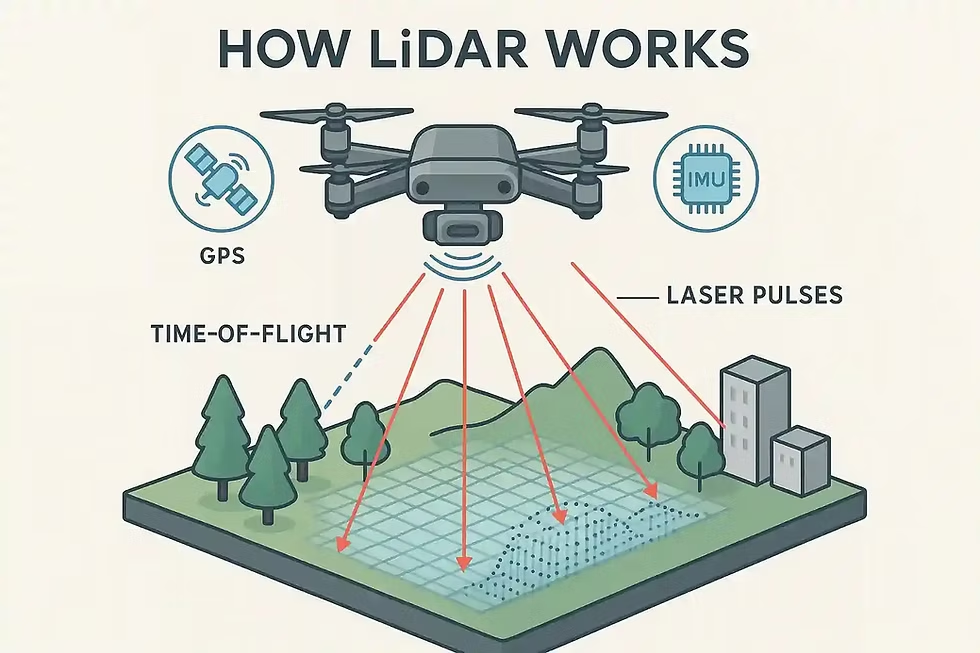
At its core, a LiDAR (Light Detection and Ranging) sensor operates on a deceptively simple principle: it emits laser pulses toward a target and measures the time it takes for each pulse to return after reflection. By calculating the time-of-flight and knowing the speed of light, the sensor can determine precise distances with remarkable accuracy. When millions of these measurements are combined, they create detailed three-dimensional point clouds that represent the surrounding environment with centimeter-level precision.
Modern LiDAR sensors employ sophisticated components including laser emitters, photodetectors, precision timing circuits, and advanced signal processing algorithms. The technology has evolved from bulky, mechanical rotating systems to compact solid-state designs that can be seamlessly integrated into various platforms. Today’s sensors can capture up to 2 million data points per second, generating real-time 3D maps that enable machines to make split-second decisions in dynamic environments.
The accuracy of contemporary LiDAR sensors is truly remarkable. High-end models can detect objects at distances exceeding 300 meters with accuracy within 2-3 centimeters, even in challenging lighting conditions. This precision makes them superior to traditional radar and camera-based systems for applications requiring detailed spatial awareness.
Types of LiDAR Sensors: Choosing the Right Solution
The LiDAR sensor landscape has diversified significantly, offering solutions tailored to specific use cases and budget constraints. Understanding the different types is crucial for industry leaders looking to implement this technology effectively.
Mechanical LiDAR represents the traditional approach, using rotating mirrors to achieve 360-degree coverage. While these systems offer excellent field of view and have been the gold standard for autonomous vehicle development, they tend to be expensive, bulky, and have moving parts that can wear over time.
Solid-State LiDAR has emerged as the game-changer for mass-market applications. These sensors have no moving parts, making them more reliable, compact, and cost-effective to manufacture. They use electronic beam steering through technologies like optical phased arrays or MEMS mirrors. Solid-state LiDAR sensors are particularly attractive for automotive OEMs looking to integrate perception systems into production vehicles at scale.
Flash LiDAR takes a different approach by illuminating the entire scene with a single laser pulse and capturing the return with a detector array, similar to how a camera captures light. This technology offers extremely fast frame rates and is ideal for applications requiring rapid scene understanding, though it typically has shorter range compared to scanning systems.
Frequency Modulated Continuous Wave (FMCW) LiDAR represents the cutting edge, offering not just distance measurement but also velocity detection through Doppler shift analysis. This capability is particularly valuable for autonomous driving, where understanding the speed of surrounding objects is as important as knowing their position.
Revolutionary Applications Across Industries
The versatility of LiDAR sensor technology has led to its adoption across an astonishing range of industries, each leveraging its unique capabilities to solve complex challenges.
Autonomous Vehicles and Advanced Driver Assistance Systems
The automotive sector remains the most prominent adopter of LiDAR technology. Self-driving vehicles rely on LiDAR sensors as their primary perception tool, creating detailed 3D maps of their surroundings to navigate safely. Companies like Waymo, Cruise, and traditional automakers are deploying vehicles equipped with multiple LiDAR sensors working in concert with cameras and radar to achieve Level 4 and Level 5 autonomy.
Beyond fully autonomous vehicles, LiDAR is becoming standard in Advanced Driver Assistance Systems (ADAS). Features like automatic emergency braking, adaptive cruise control, and lane-keeping assistance are being enhanced with LiDAR’s superior object detection capabilities, particularly in challenging conditions where cameras struggle, such as low light or adverse weather.
Robotics and Industrial Automation
In manufacturing and logistics, LiDAR sensors are enabling a new generation of intelligent robots. Automated guided vehicles (AGVs) and autonomous mobile robots (AMRs) use LiDAR for navigation, obstacle avoidance, and precise positioning in warehouses and factories. These systems can operate 24/7, optimizing supply chain operations and reducing labor costs while improving safety by removing humans from hazardous environments.
Robotic arms equipped with LiDAR can perform complex assembly tasks with unprecedented precision, adapting to variations in part positioning in real-time. This flexibility is crucial for manufacturers moving toward mass customization and just-in-time production models.
Smart City Infrastructure and Urban Planning
Municipalities worldwide are deploying LiDAR sensors on vehicles, drones, and fixed installations to create detailed digital twins of urban environments. These 3D models support numerous applications: optimizing traffic flow, planning infrastructure improvements, managing utilities, and enhancing public safety. LiDAR-equipped street furniture can monitor pedestrian traffic, detect accidents, and support smart parking systems.
In construction and architecture, LiDAR enables precise as-built documentation, progress monitoring, and quality control. Drones equipped with LiDAR can survey large construction sites in minutes, providing data that would take traditional surveying teams days to collect.
Agriculture and Environmental Monitoring
Precision agriculture has been revolutionized by LiDAR technology. Farmers use drone-mounted LiDAR sensors to create detailed topographical maps of their fields, identifying drainage issues, optimizing irrigation systems, and monitoring crop health. The technology can penetrate vegetation canopy to assess plant density and biomass, providing insights that drive yield optimization.
Environmental scientists employ LiDAR for forest management, carbon sequestration measurement, flood modeling, and habitat mapping. The technology’s ability to penetrate vegetation makes it invaluable for understanding ecosystem structure and monitoring changes over time.
Archaeology and Cultural Heritage Preservation
LiDAR has emerged as a powerful tool for archaeologists, capable of revealing ancient structures hidden beneath dense vegetation. In recent years, LiDAR surveys have discovered thousands of previously unknown Mayan structures in Central America and mapped ancient settlements across various continents. The non-invasive nature of the technology makes it ideal for documenting and preserving cultural heritage sites.
Market Dynamics and Growth Trajectory
The LiDAR sensor market is experiencing robust growth driven by multiple factors. The automotive sector’s push toward autonomy remains the primary catalyst, with major OEMs committing billions to ADAS and self-driving technology development. However, diversification into robotics, smart infrastructure, and consumer electronics is creating additional revenue streams and reducing dependence on any single application.
Cost reduction has been a critical enabler of broader adoption. Early automotive-grade LiDAR systems cost upwards of $75,000 per unit. Today, companies are producing sensors for under $500, with some targeting the $100 price point for mass-market vehicles. This dramatic cost decline is making LiDAR economically viable for applications that were previously out of reach.
The competitive landscape is intensifying, with established players like Velodyne, Luminar, Innovusion, and Hesai competing alongside automotive suppliers developing in-house capabilities and tech giants like Apple and Google investing heavily in the technology. This competition is driving rapid innovation in performance, reliability, and cost-effectiveness.
Emerging Trends and Future Developments
Several exciting trends are shaping the future of LiDAR sensor technology. Chip-scale LiDAR is moving from laboratory prototypes to commercial products, promising to integrate complete LiDAR systems onto silicon chips. This miniaturization will enable integration into smartphones, wearables, and other consumer devices, potentially creating massive new markets.
AI-enhanced LiDAR is another frontier, with machine learning algorithms being developed to process point cloud data more efficiently and extract higher-level insights. These systems can classify objects, predict behaviors, and make decisions with minimal human intervention, crucial for autonomous systems operating in complex environments.
Multi-spectral and hyperspectral LiDAR is expanding the technology’s capabilities beyond simple distance measurement. By analyzing the intensity and wavelength of returned light, these systems can identify material composition, detect chemical signatures, and provide rich data for applications ranging from mineral exploration to pollution monitoring.
The development of 4D LiDAR systems that capture spatial information plus velocity is providing richer data for autonomous navigation and tracking applications. This additional dimension enables more sophisticated scene understanding and prediction of dynamic object movements.
Implementation Challenges and Considerations
Despite its tremendous potential, deploying LiDAR sensor technology comes with challenges that industry leaders must carefully navigate. Cost remains a barrier for many applications, though this is rapidly improving. Organizations must carefully evaluate total cost of ownership, including not just the sensor hardware but also integration, calibration, maintenance, and data processing infrastructure.
Data management presents another significant challenge. A single LiDAR sensor can generate terabytes of data daily, requiring robust storage, transmission, and processing capabilities. Organizations need to invest in edge computing solutions and efficient data compression algorithms to handle this deluge of information.
Environmental limitations still exist, though they are being steadily addressed. While LiDAR performs better than cameras in low light, heavy rain, fog, and snow can still degrade performance. Multi-sensor fusion strategies that combine LiDAR with radar, cameras, and ultrasonic sensors are becoming standard practice to ensure reliable operation in all conditions.
Regulatory and standardization issues are evolving as the technology matures. Industries like automotive are working toward common performance standards and safety certifications. Organizations implementing LiDAR must stay informed about emerging regulations and ensure their systems comply with relevant requirements.
Strategic Recommendations for Industry Leaders
For executives considering LiDAR sensor implementation, several strategic considerations are paramount. First, start with clear use cases that deliver measurable ROI. Don’t deploy LiDAR technology simply because it’s innovative; ensure it solves specific business problems or creates tangible value.
Build internal expertise or partner with experienced integrators. LiDAR systems require specialized knowledge for installation, calibration, and maintenance. Developing this capability in-house or through strategic partnerships is essential for long-term success.
Plan for scalability from the outset. Choose platforms and architectures that can grow with your needs, supporting additional sensors, increased data volumes, and evolving applications. Avoid vendor lock-in by prioritizing open standards and interoperable systems.
Invest in data analytics capabilities. The value of LiDAR lies not in the raw data but in the insights extracted from it. Develop or acquire the analytical tools and expertise needed to transform point clouds into actionable intelligence.
Conclusion: The LiDAR Revolution Is Just Beginning
LiDAR sensor technology has transitioned from experimental novelty to essential infrastructure for the intelligent systems that will define our future. As costs continue to fall and performance improves, we can expect to see LiDAR deployed in increasingly diverse applications, from the vehicles we ride in to the devices we carry, from the factories that produce our goods to the cities where we live.
For industry leaders, the question is no longer whether to adopt LiDAR technology but how quickly and strategically to integrate it into operations. Those who move decisively to harness the power of precise 3D perception will gain significant competitive advantages in efficiency, safety, and innovation. The organizations that thrive in the coming decade will be those that recognize LiDAR not just as a sensor but as a foundational technology enabling a new era of intelligent automation and spatial awareness.
The LiDAR revolution is accelerating, and the time to act is now.
Follow us to get the latest information and new : aarokatech.com