

The SkyDrive eVTOL is making unprecedented strides in the first quarter of 2026, transforming the futuristic concept of “flying cars” into a tangible, everyday reality. For professionals closely following the intersection of advanced electronics, sustainable infrastructure, and urban transport here at AarokaTech, SkyDrive’s recent progress represents a monumental shift. The company’s relentless push to bring the air mobility revolution to daily life has yielded critical milestones, cementing its position as a global leader in the Advanced Air Mobility (AAM) sector.
A Major Leap Toward Practical Application: The Tokyo Demo Flight
One of the most defining moments for the SkyDrive eVTOL program this year was the highly anticipated demo flight conducted in the Tokyo Bay area this past February. This event captured significant attention across domestic and international technology sectors, and for good reason. It was not just a visual spectacle; it was a deeply technical validation of urban air mobility infrastructure.
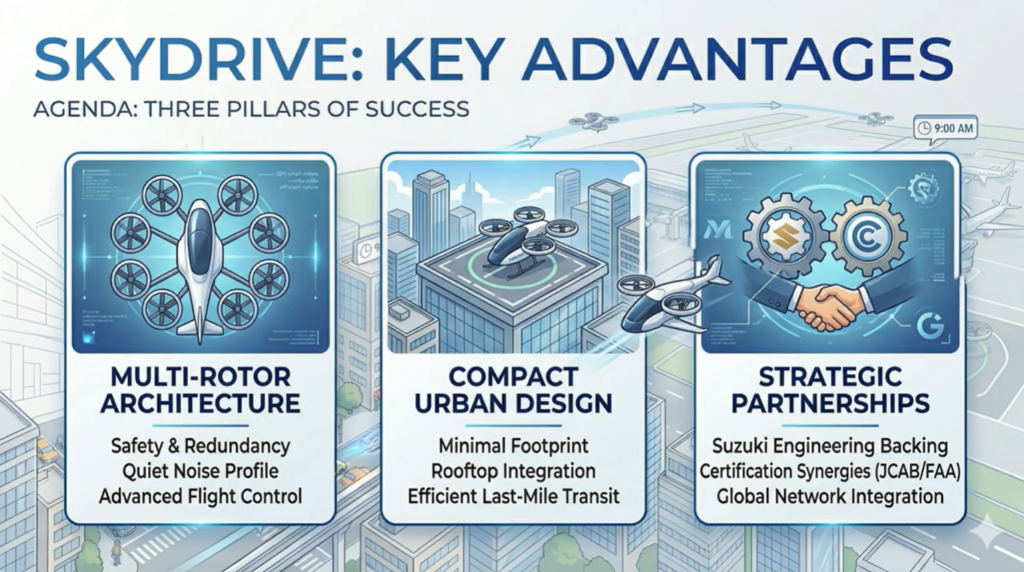
In a strategic collaboration with the Tokyo Metropolitan Government, Mitsubishi Estate, and Kanematsu, SkyDrive executed Japan’s first comprehensive verification focused on “actual operations.” Moving beyond a mere flight demonstration, the initiative successfully tested the automation and technological optimization of vertiport management. This hands-on validation provided media, urban planners, and the global B2B tech community with a concrete vision of how electric Vertical Takeoff and Landing (eVTOL) aircraft will seamlessly integrate into densely populated urban landscapes.
Elevating to a National Strategy and Driving Public-Private Synergy
The impact of the SkyDrive eVTOL extends far beyond corporate innovation; it has now become a cornerstone of public policy. In a major regulatory victory, eVTOLs—commonly referred to as “Flying Cars” in Japan—have been officially selected as a key product and technology within one of the 17 Priority Fields of the Japanese Government’s overarching Growth Strategy.
This official designation signifies that SkyDrive’s mission is no longer viewed merely as a private venture. Instead, it is recognized as a core pillar of a national strategy designed to drive Japan’s next-generation economy. Furthermore, the Japanese Cabinet has officially positioned eVTOL technology as sustainable infrastructure crucial for regional revitalization. Combined with the shared vision established at the Osaka Roundtable to actively operate “100 aircraft by 2035,” the roadmap for robust public-private integration is accelerating at a remarkable pace. As the undisputed frontrunner in this burgeoning industry, SkyDrive continues to spearhead both the regulatory design and the broader social implementation of aerial mobility.
Breaking Ground in the Type Certification Process
Navigating the complex regulatory landscape of aviation is a notoriously rigorous process, but Q1 2026 brought a massive breakthrough. In its ongoing pursuit to obtain Type Certification from the Japan Civil Aviation Bureau (JCAB) and the U.S. Federal Aviation Administration (FAA), SkyDrive successfully reached a pivotal agreement with the Ministry of Land, Infrastructure, Transport and Tourism (MLIT).
The formalized agreement on the General Certification Plan (GCP) establishes a definitive, transparent path toward final certification. For investors and electronics manufacturing partners tracking this sector on AarokaTech, this is a critical development. It significantly reduces development risks and clears a massive regulatory bottleneck. This localized progress within the Japanese regulatory framework also serves as a highly positive catalyst, accelerating the parallel certification process currently underway in the United States.
Continuous Expansion of the Global AAM Ecosystem
While dominating the domestic landscape, the global expansion of the SkyDrive eVTOL ecosystem is rapidly gaining momentum. Throughout the first quarter, the company made highly strategic incursions into the Middle Eastern and Asian markets. SkyDrive advanced major aircraft purchase agreements with AeroGulf Services in Dubai and 7A Drones in Taiwan.
Simultaneously, the company solidified its operational foundation in North America through a vital partnership with Aeroauto. Beyond standard passenger transport, the formulation of a dedicated emergency medical transportation route between remote islands in Taiwan serves as a profound testament to the technology’s ultimate value. It proves that these advanced aircraft are not just about convenience—they are purpose-built to provide critical, life-saving social value.
Transitioning from a Visionary Concept to a Real-World Industry
The aggressive technological and strategic activities of Q1 clearly demonstrate that the SkyDrive eVTOL is no longer an imaginary vehicle from science fiction. It is rapidly evolving into a highly viable, deeply integrated real-world industry. By expanding the available options for aerial mobility, companies can alleviate crippling urban traffic congestion while providing unparalleled support for emergency medical services.
A defining feature of SkyDrive’s multirotor architecture is its ability to operate without a traditional runway. This localized vertical takeoff and landing capability makes it incredibly efficient to install vertiports directly within our daily living spaces and city centers. As seamless aerial travel becomes available right from modern office complexes and residential hubs, it promises to save massive amounts of time while transforming transit into a frictionless experience.
To fully realize this connected future, the continued collaboration of global stakeholders—including governments, smart city municipalities, and electronics and tech business partners—is absolutely indispensable. As we monitor these exciting developments at AarokaTech, it is clear that this global network will be the key to ensuring that sustainable, automated aerial mobility becomes a natural and essential part of everyday life.
Raw Cockpit POV: