

PIC64-HPSC Spaceflight Computing designs are actively revolutionizing the aerospace and semiconductor industries. While the microprocessor (MPU) itself delivers an astonishing 100× leap in spacecraft compute capabilities, the processor is only one fraction of a mission-ready design. Designing a spaceflight computer is remarkably similar to building a rugged expedition vehicle for unforgiving, extraterrestrial terrain. The engine is undoubtedly crucial, but you cannot travel on an engine alone. You require reliable fuel delivery, dependable navigation, rugged communication links, and resilient storage that will not fail when environmental conditions become incredibly harsh.
In the realm of modern spacecraft electronics, the “engine” is often a high-performance processor. However, without qualified, radiation-tested supporting components surrounding it, raw computing performance cannot translate into long-term mission success. This is where comprehensive, system-level engineering takes the spotlight.
This comprehensive guide, brought to you by AarokaTech, highlights how Microchip’s robust space-grade component portfolio perfectly complements PIC64-HPSC Spaceflight Computing system designs. We will explore how radiation-hardened (rad-hard) and radiation-tolerant building blocks—spanning critical memory, precision timing, networking interfaces, and power regulation—help engineers jump-start their development cycles using a pre-engineered, complete system approach.
The Dawn of a 100x Performance Leap
The PIC64-HPSC series of microprocessors, alongside its accompanying software development environment, provides a monumental 100× improvement in the computational capacity of spacecraft computers when compared against traditional, legacy solutions. These MPUs are not just faster; they bring modern, terrestrial datacenter capabilities into orbit.
These state-of-the-art processors feature advanced technologies previously unseen in space applications. These include hardware virtualization, Artificial Intelligence (AI) and Machine Learning (ML) vector processing, Ethernet Time Sensitive Networking (TSN), and Remote Direct Memory Access over Converged Ethernet (RoCE) v2. Furthermore, they support PCIe® Gen 3, Compute Express Link® (CXL®) 2.0, and cutting-edge post-quantum cryptography. Such expansive capabilities allow these components to support complex applications extending from Low Earth Orbit (LEO) constellations all the way to deep space exploration missions.
A Pre-Engineered Complete Solution
To help engineering teams jump-start their designs around these advanced devices, Microchip offers a meticulously pre-engineered space system solution. This expansive ecosystem includes a wide array of radiation-hardened or radiation-tolerant components. These parts are specifically intended to support stringent design requirements such as power management, high-speed timing, and front-panel or backplane interfaces used to convey critical sensor data or remotely control actuators.
This holistic approach is positioned as a “Proven, Validated, Ready Solution.” By drastically reducing integration friction, it helps engineering teams focus their immediate attention on delivering their custom software and payload designs on time, rather than troubleshooting foundational hardware compatibility issues.
Microchip positions its comprehensive broadline portfolio as the ultimate way to pair these MPUs with carefully selected companion components. The intent is to provide robust building blocks that seamlessly support key spacecraft computing needs.
Essential Building Blocks for PIC64-HPSC Systems
Space-Grade Memory Options for Fast Access
High-performance computing requires equally fast and reliable memory. For boot sequences, code storage, and rapid data access, there are multiple recommended space-grade memory devices tailored for these specialized designs:
- NOR Flash Memory: Components like the SST26LF064RT (a radiation-tolerant 64 Mbit serial Quad I/O Flash) and the SST38LF401RT (a radiation-tolerant 64 Mbit parallel Flash) are highly recommended. Both operate seamlessly in extreme temperatures ranging from –55 to 125°C and feature excellent Single Event Latch-up (SEL) and Total Ionizing Dose (TID) performance highlights.
- SRAM Solutions: The AT68166H radiation-hardened SRAM is an exceptional option. It also lists a –55 to 125°C operational range, alongside robust SEL and TID specifications required for critical cache data.
These diverse options give designers the necessary flexibility when selecting nonvolatile storage and SRAM within the typical, yet severe, environmental constraints dictated by orbital hardware.
Precision Timing and Clocking Solutions
A high-speed processor requires immaculate timing, especially when dealing with advanced interconnects like PCIe and CXL. For demanding clocking needs, specialized radiation-hardened and radiation-tolerant 100 MHz oscillators are absolutely essential.
Top hardware recommendations include the 1603x100M000B(RH) and the 1203x100M000B(RX). Both of these highly reliable oscillators are explicitly called out for their impressive –55 to 125°C temperature operating range and their high TID resilience, ensuring that the system clock remains perfectly stable even during severe solar radiation events.
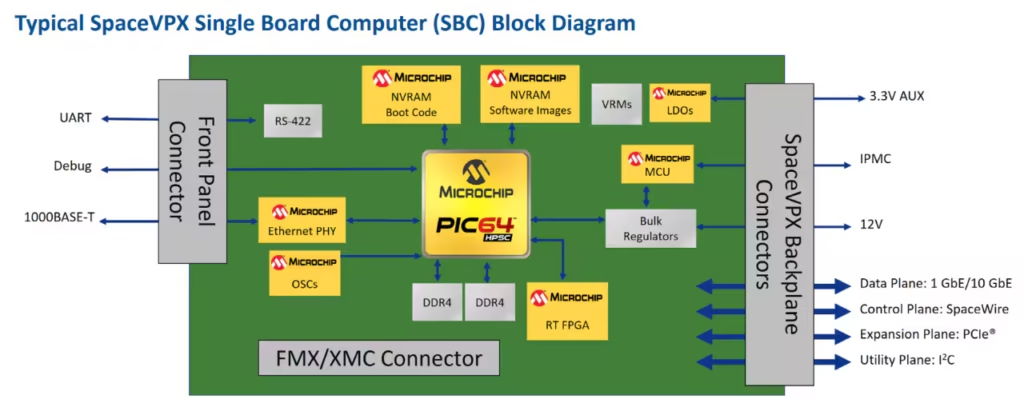
Robust Connectivity: Ethernet PHYs and SpaceWire Routing
Modern spacecraft systems often require reliable, high-bandwidth connectivity across multiple internal subsystems. This allows for real-time sensor fusion and data processing. To achieve this, specific networking components are heavily utilized:
- Ethernet PHYs: The VCS8540/41RT copper PHYs and the VC8574RT four-port dual media QSGMII/SGMII Gigabit Ethernet PHY provide robust, high-speed networking capabilities essential for enabling TSN capabilities.
- SpaceWire Routers: The AT7910 SpaceWire Router natively supports up to 10 SpaceWire links operating from 2 to 200 Mbps, acting as the reliable nervous system for legacy and modern subsystem integration.
These critical parts help enable front-panel and backplane interface needs commonly found in modern spacecraft compute platforms, such as the typical SpaceVPX Single-Board Computer (SBC) architectures.
Unwavering Power Architecture Support
Finally, none of the aforementioned computing components can function without a clean, stable, and isolated power supply. To address common design requirements related to powering higher-performance compute platforms under space conditions, specific space-grade power components are necessary:
- LDO Regulators: The MIC6930RT radiation-tolerant 3A Low-Dropout (LDO) regulator ensures a smooth, noise-free voltage drop for sensitive digital logic circuits.
- Isolated DC-DC Converters: The SAS0-28 and SAS0-120 “50 Watts series” radiation-hardened isolated converters provide robust bulk power delivery. Notably, these advanced devices can be paralleled—combining up to four chips—for approximately 200W of total capability, depending on the specific payload and mission configuration.
Together, these vital power elements ensure that the complete processing payload remains fueled from launch sequence through its final deployment phase.
Accelerating Your Aerospace Architecture
If you are beginning a new aerospace project, evaluating a total system solution is the smartest path forward. By carefully reviewing recommended companion parts across memory, clocking, connectivity, and power, you can confidently align your architecture early with components strictly intended for space applications. The deep integration of PIC64-HPSC Spaceflight Computing ecosystems marks a transformative era for next-generation satellites, rovers, and deep-space probes, effectively delivering terrestrial datacenter performance to the final frontier.