

Orbbec 3D vision solutions are taking center stage at Automate 2026 in Chicago, introducing a powerful shift in how robots perceive and interact with the physical world. As industrial environments demand higher precision, faster throughput, and greater autonomy, traditional vision systems frequently hit performance ceilings. At Booth 14045 in the North Building, Orbbec is answering these industry challenges by showcasing an advanced portfolio of industrial-grade hardware integrated seamlessly with cutting-edge edge AI.
From solving classic optical blind spots like highly reflective metals and transparent containers to enabling high-density mapping for autonomous mobile machinery, these innovations represent a massive leap forward for smart manufacturing and logistics logistics pipelines worldwide.
The Convergence of 3D Sensing and Edge AI
A major highlight of the exhibition is Orbbec’s hardware-software integrated architecture, which moves beyond simple depth data collection to achieve true spatial intelligence. By embedding artificial intelligence directly at the edge, these systems allow robotic arms and automated guided vehicles (AGVs) to process complex environmental data in real time with minimal latency.
LingBot-Depth: Eliminating Traditional Optical Blind Spots
Industrial automation has long been plagued by material-based perception failures. Standard 3D sensors often fail when encountering:
- Highly reflective surfaces (machined metals, polished steel, and chrome)
- Transparent objects (glass vials, laboratory pipettes, and clear acrylics)
- Low-texture or repetitive patterns (blank white drywall, uniform warehouse containers, and security fencing)
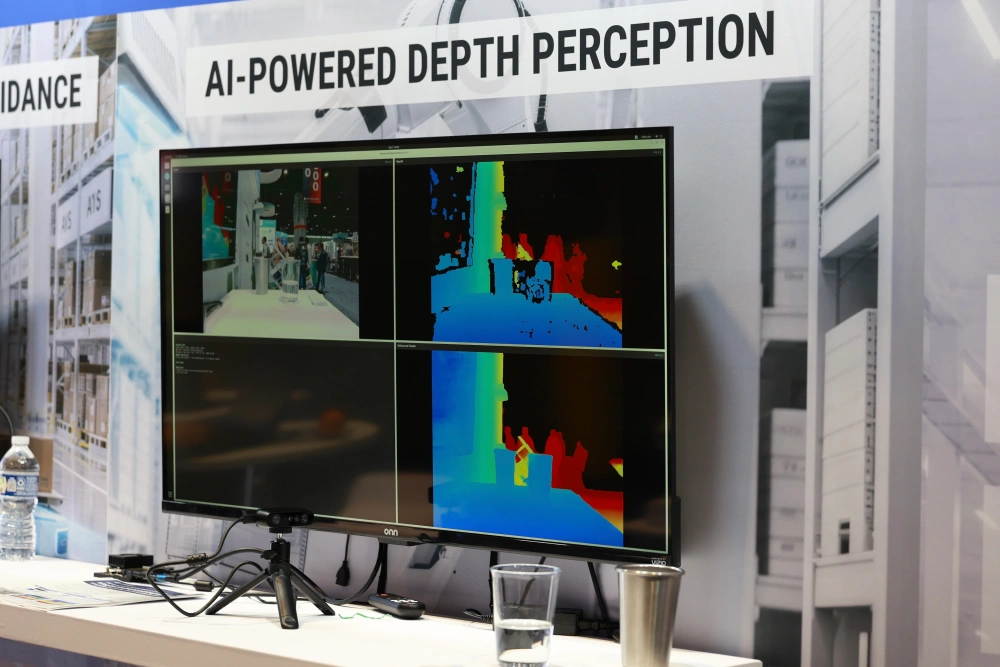
To solve these specific bottlenecks, Orbbec has partnered with Robbyant (an Ant Group company) to launch the LingBot-Depth for Gemini 330 Series (the LingBot Enhanced Depth Filter).
This solution utilizes chip-level, high-precision training data derived directly from Orbbec’s Gemini 330 cameras. By feeding clean, high-quality depth streams into Robbyant’s in-house Vision-Language-Action (VLA) models, the system dramatically improves robotic manipulation and task success rates. Optimized for the NVIDIA Jetson Orin platform, it leverages NVIDIA CUDA and TensorRT acceleration to handle real-time depth hole filling, noise removal, and sharp edge refinement directly at the industrial edge.
Industrial-Grade Cameras Engineered for Extreme Environments
Beyond AI software filters, Orbbec is demonstrating ruggedized, specialized hardware configurations optimized for specialized physical tasks across assembly lines and logistics hubs.
1. Customizable 3D DLP Camera for High-Precision Assembly
For high-stakes tasks like sub-millimeter inspection and electronic component placement, Orbbec introduced its customizable 3D Digital Light Processing (DLP) structured light camera.
- Metrology-Grade Accuracy: Achieves an impressive $\approx 0.07\text{ mm}$ VDI/VDE accuracy.
- Repeatability: Delivers $0.05\text{ mm}$ Z-repeatability at a distance of $0.5\text{ m}$.
- Form Factor: Compact and lightweight, specifically balanced to prevent mechanical strain when mounted directly to robotic wrists or end-effectors.
- Adaptive Capture Modes: Features specialized software toggles including Fast, High-Reflectivity, and Accurate modes to dynamically adjust to varying material surfaces on a fast-moving assembly line.
2. Gemini 435Le: Driving Next-Gen Logistics and Forklift Autonomy
Warehouses are highly dynamic, unpredictable environments where dust, vibration, and shifting lighting wreck havoc on standard sensors. The Gemini 435Le stereo 3D camera is engineered explicitly to withstand these conditions.
In a live demonstration at Automate 2026, the camera powers an autonomous forklift solution. By producing low-noise, ultra-high-density point clouds, it ensures reliable obstacle avoidance, precise floor-level pallet fork detection, and stable simultaneous localization and mapping (SLAM) even when moving over uneven industrial flooring.
3. Gemini 305g: Vibrational and Electromagnetic Resilience
Designed for heavy-duty robotic arm integration, the ultra-compact Gemini 305g stereo camera features GMSL2/FAKRA connectivity. This specialized low-loss cabling allows the sensor to transmit massive amounts of high-speed depth data without suffering from electromagnetic interference (EMI) or signal degradation caused by severe mechanical vibrations from high-speed manufacturing movements.
Global Validation and Scaling Manufacturing Resilience
Orbbec’s technology is already deeply integrated into the global tier-1 automation ecosystem. At the event, Teradyne Robotics highlighted the deployment of the Gemini 305g within their UR AI Trainer. This platform streamlines high-quality spatial data collection, providing the vital ground-truth datasets required to train advanced Physical AI models for intricate electronics assembly tasks.
To support this massive global footprint—which currently includes serving over 1,600 robotics companies and capturing over 70% of China’s service robot vision market—Orbbec is aggressively scaling its production infrastructure. The company’s advanced intelligent manufacturing hub in Shunde, China, provides highly flexible Joint Design Manufacturing (JDM) and Contract Manufacturing (CM) services.
Simultaneously, the rollout of their upcoming RVMC factory in Vietnam establishes a highly resilient, multi-site global supply chain strategy. With a projected global capacity exceeding 6 million robotic vision units annually, Orbbec ensures that global enterprises can scale their automation projects without fearing localized supply chain constraints.
Get the latest update on aarokatech.com