
As automotive lighting systems evolve from simple bulbs into highly intelligent, adaptive modules, the demand for robust, efficient, and space-saving power management solutions is accelerating. Meeting this critical industry need, Diodes Incorporated (Diodes) has significantly strengthened its power management portfolio with the release of the AL8859Q.
Here at AarokaTech, we closely track the innovations driving automotive electronics forward. The AL8859Q is a highly advanced, automotive-compliant multi-phase SPI boost controller engineered specifically to tackle the rigorous functional safety, EMI, efficiency, and power density requirements of modern advanced headlight control units.
By serving as the primary constant-voltage pre-stage, this integrated device seamlessly powers adaptive front lighting systems—including high beams, low beams, turn indicators, daytime running lights (DRL), fog lights, and cornering lights—all within a single, unified module.
High-Efficiency Multi-Phase Architecture
Modern vehicles operate on a variety of power networks, requiring highly adaptable power management ICs. The AL8859Q rises to the challenge by integrating a current-mode multi-phase boost architecture featuring a remarkably wide input voltage range of 4.5V to 60V. This allows the controller to operate flawlessly across standard 5V, 12V, 24V, and even 48V automotive supply rails.
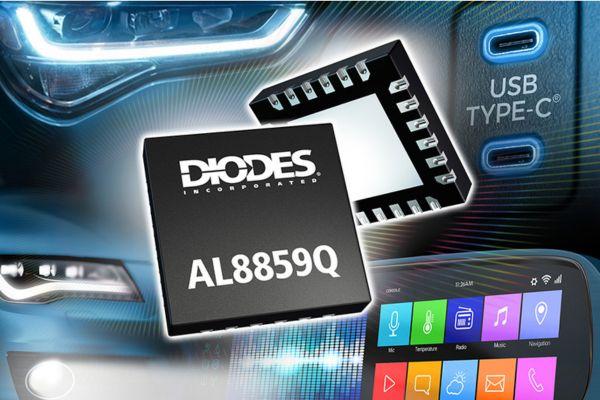
A single AL8859Q device inherently supports two phases. However, for applications demanding extreme power, engineers can easily synchronize multiple devices to scale up to three or four phases.
Key performance metrics include:
- Power Output: Capable of driving 100W to 400W of output power.
- System Efficiency: Achieves an impressive ~95% efficiency, minimizing energy waste.
- Thermal Management: Delivers a highly balanced thermal distribution with exceptionally low ripple current.
- Voltage Accuracy: Boasts a voltage accuracy of ±0.5% at 50V (typ.), guaranteeing a highly stable supply for downstream LED drivers, which translates to consistent light reliability across all operating conditions.
Software Programmability and Functional Safety
One of the most significant advantages of the AL8859Q is its deep software programmability. Utilizing an SPI digital interface, automotive engineers can easily program the internal register map to exert precise control over output voltage, current limits, switching frequencies, and critical protection thresholds.
This flexibility allows a single hardware platform design to be rapidly reconfigured and adapted across multiple different vehicle models and lighting applications, drastically reducing development time and engineering overhead.
Furthermore, the integration of one-time programmable (OTP) memory enables standalone or fail-safe operation directly off the production line. This drastically reduces the system’s dependency on an external Microcontroller Unit (MCU), creating a much more robust and fault-tolerant architecture.
To ensure functional safety compliance, the device features an extensive suite of onboard diagnostics. This includes continuous VDRIVE monitoring, SPI error detection, precise current limiting, overvoltage and undervoltage protection, and thermal warning/shutdown capabilities.
Conquering EMI and PCB Space Constraints
Electromagnetic Interference (EMI) is a massive hurdle in automotive electronic design. The AL8859Q tackles this by incorporating advanced spread-spectrum frequency modulation. This integrated feature makes it significantly easier for designers to achieve strict CISPR 25 Class 5 EMI compliance, reducing the need for bulky, expensive external filtering components and ultimately lowering the overall Bill of Materials (BOM) cost.
Finally, space on an automotive PCB is always at a premium. Diodes Incorporated addresses this by housing the AL8859Q in a highly compact wettable flank V-QFN4040-24/SWP package, measuring just 4mm x 4mm. The wettable flanks are critical for automotive manufacturing, as they allow for completely automated optical inspection (AOI) to guarantee solder joint reliability in high-vibration automotive environments.
By minimizing external component stress and maximizing digital control, the AL8859Q stands out as a premier solution for the next generation of smart automotive power systems.