

At the forefront of aviation innovation, the SkyDrive eVTOL has officially reached a groundbreaking speed of 100km/h. This remarkable achievement by the Japan-based developer, SkyDrive Inc., signals a massive leap forward for the future of short-hop, inter-urban air mobility. As of June 24, 2026, the successful high-speed testing of the SkyDrive Model SD-05 has proven the vehicle’s immense potential, confirming critical design elements that will pave the way for commercialization in 2028. Here at aarokatech.com, we are closely following how this revolutionary aircraft is reshaping our understanding of modern transportation.
The True Significance of the 100km/h Milestone
Hitting the 100km/h mark is far more than just an impressive number on an airspeed indicator. For the engineers behind the SkyDrive eVTOL, this milestone represents the ultimate validation of years of theoretical design and rigorous analysis.
The development of any advanced aircraft begins with complex computer simulations, ground testing, and component analysis. However, there are unique aerodynamic forces, structural vibrations, and intricate system interactions that can only be fully understood when the aircraft is actually in the sky. During high-speed flight, aerodynamic drag and structural loads shift dramatically. By successfully operating at 100km/h, SkyDrive has proven that its propulsion systems, flight control systems, and on-board avionics can handle the intense demands of real-world commercial flight speeds.
Because this aircraft utilizes a completely novel concept that differs significantly from traditional fixed-wing airplanes and standard helicopters, historical aviation data is insufficient. Every metric had to be independently verified through live testing. This successful flight proves that the predictive models used during the design phase were highly accurate, granting the engineering team unparalleled confidence moving forward.
Why the Compact Multicopter Design is a Game-Changer
Since its inception, SkyDrive has championed a unique, compact multicopter concept designed specifically for crowded urban environments. Unlike other electric Vertical Takeoff and Landing vehicles that rely on bulky fixed wings, the SkyDrive eVTOL relies on 12 independent rotors managed by a highly advanced, centralized flight control system.
This design choice offers several profound benefits for urban air mobility:
- Unmatched Flexibility: The absence of fixed wings allows the aircraft to take off and land in much tighter spaces, opening up versatile vertiport locations across dense cityscapes.
- Simplified Operations: A streamlined structural design translates to fewer moving parts, which subsequently reduces long-term operational and maintenance costs.
- High-Speed Stability: Prior to this test, the primary question was whether a wingless multicopter could maintain stability at high forward speeds. The recent 100km/h flight effectively silences those doubts, confirming that the architecture functions flawlessly even under significant aerodynamic pressure.
By ensuring the viability of this compact design, SkyDrive has solidified the multicopter as a highly efficient, practical solution for future urban transport networks.
The Rigorous Testing Journey Behind the Success
Achieving stable, high-speed flight does not happen overnight. The SkyDrive eVTOL’s success is the direct result of a meticulous, multi-tiered testing regimen designed to prioritize safety and performance at every step.
The developmental roadmap included:
- Extensive Flight Test History: Building on the foundation laid by the earlier SD-03 prototype, the engineering team has successfully executed hundreds of test flights, gathering invaluable real-world data.
- Comprehensive Component Testing: Beyond the skies, rigorous standalone tests were conducted on the aircraft’s electric motors, high-capacity batteries, and individual rotors.
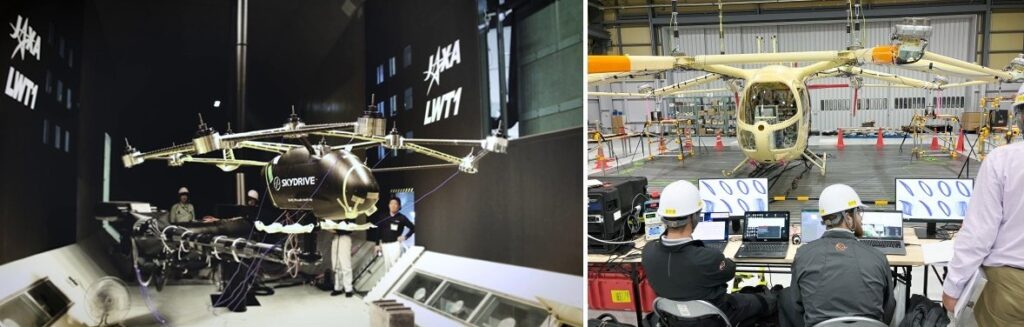
- Advanced Aerodynamic Analysis: The team utilized the state-of-the-art wind tunnel facilities at JAXA (the Japanese Aerospace Exploration Agency) to conduct vital aerodynamic performance and ground vibration testing.
- Incremental Performance Tuning: Data gathered from cautious low- and mid-speed flights allowed pilots and software engineers to meticulously tune the flight control systems before confidently pushing the aircraft to 100km/h.
Looking Ahead to 2028 and Beyond
The global eVTOL industry is rapidly evolving. We are no longer in the phase of merely proving that electric flying cars can hover. Today, the focus has shifted entirely to demonstrating high-speed stability, gathering stringent regulatory data, and proving the economic viability of commercial fleets.
With this monumental 100km/h test completed, SkyDrive is perfectly positioned to accelerate its certification processes with aviation authorities. The company plans to continue expanding the aircraft’s flight envelope, rigorously testing performance limits to ensure absolute safety for future passengers.
As we look toward the horizon, the dream of soaring above city traffic is quickly becoming a tangible reality. Keep checking back with aarokatech.com as we continue to track the SkyDrive eVTOL and its exciting journey toward full commercial operation in 2028.