

The Kioxia Dell 9.8PB Server marks a significant leap in the evolution of data center architecture. On May 15, 2026, Kioxia Corporation and Dell Technologies announced a record-breaking storage infrastructure solution. This collaboration has successfully packed 9.8 petabytes (PB) of all-flash storage into a compact 2U server configuration.
This milestone is primarily aimed at the insatiable appetite for data in the artificial intelligence (AI) era. As generative AI models and large-scale data lakes grow, the physical footprint and power requirements of storage have become critical bottlenecks. The new benchmark set by these two industry leaders offers a path toward massive scalability without the typical spatial or energetic penalties.
The Hardware Foundation: Dell PowerEdge R7725xd
At the heart of this storage-optimized platform is the Dell PowerEdge R7725xd server. Designed specifically for modern, data-centric workloads, this server utilizes the latest AMD EPYC™ processors to provide the necessary compute overhead for massive data ingestion.
The R7725xd is built to handle the density required by the AI lifecycle. It is an air-cooled system that complements GPU-heavy servers, acting as the primary repository for model training and data management. Flexibility is a core feature, allowing users to configure the system to suit specific enterprise needs.
To ensure that data doesn’t just sit idle, the server supports up to five 400 Gbps Network Interface Cards (NICs). This high-bandwidth networking capability allows organizations to fill and move data through pipelines with extreme efficiency, ensuring that the stored 9.8 PB is always ready for processing.
Powering the Density: KIOXIA LC9 Series SSDs
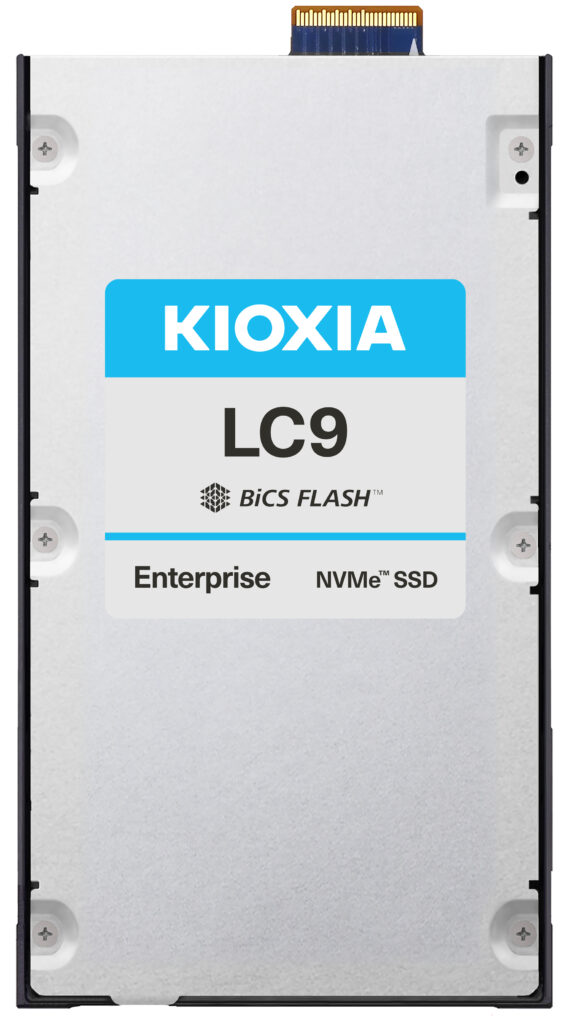
The true engine of this 9.8 PB milestone is the KIOXIA LC9 Series SSD. These are high-density enterprise NVMe™ drives that reach an astounding capacity of 245.76 terabytes (TB) per single drive. For this specific configuration, Dell and Kioxia utilized 40 of these E3.L form factor drives.
While 30.72 TB drives have been the common standard for high-density setups, the Kioxia LC9 Series represents a generational shift. By moving to a 245.76 TB capacity, organizations can significantly consolidate their hardware stacks.
The PCIe® 5.0 performance of these drives ensures that the massive capacity is matched by high-speed data access. This is the industry’s first NVMe SSD at this specific capacity built precisely for the demands of generative AI and hyperscale environments.
Unparalleled Efficiency and Reduced TCO
The impact of the Kioxia Dell 9.8PB Server on Total Cost of Ownership (TCO) cannot be overstated. Traditionally, achieving 9.8 PB of storage would require a sprawling infrastructure. A comparable setup using standard 30.72 TB drives would require seven additional servers.
Beyond the cost of the hardware, those seven extra servers would carry 280 additional drives. This results in approximately eight times the power consumption compared to the single Kioxia/Dell 2U solution. By consolidating into a single server, data centers can drastically reduce their electricity bills and cooling requirements.
Space efficiency is equally dramatic. Instead of taking up a significant portion of a server rack, the 9.8 PB of storage occupies only 2U of space. This allows organizations to scale their AI infrastructure within existing facilities rather than expanding their physical data center footprint.
Architecting for the AI Revolution
Generative AI environments demand a fundamentally different approach to infrastructure. High-density servers like the Dell PowerEdge R7725xd, paired with Kioxia’s high-capacity SSDs, allow for “massive ingestion streams.” This is vital for training the next generation of Large Language Models (LLMs).
Furthermore, large-scale data lakes can now be scaled effortlessly. Instead of managing dozens of individual servers for a single data lake, engineers can manage a handful of these high-density units. This simplification of the storage layer reduces management complexity and improves system reliability.
Large-scale backups and data retention also benefit from this density. Organizations dealing with petabyte-scale compliance or archival requirements can now handle these tasks in a fraction of the previous footprint, improving overall operational agility.
A Shared Commitment to Data Innovation
The partnership between Dell Technologies and Kioxia is built on a long history of enabling scalable infrastructure. This latest achievement reflects their shared commitment to advancing high-density architectures that prioritize both performance and efficiency.
Arun Narayanan of Dell Technologies noted that as AI workloads become more demanding, the infrastructure must keep pace. The combination of the PowerEdge R7725xd and Kioxia’s high-capacity SSDs ensures that customers can scale their AI ambitions without sacrificing energy efficiency.
Akihiro Kimura from Kioxia echoed this sentiment, stating that this solution isn’t just about packing more bits into a box; it’s a shift in how AI infrastructures are architected. The ability to handle massive data streams in a small footprint is the new standard for the hyperscale era.
Conclusion: The Future of the Data Center
The Kioxia Dell 9.8PB Server represents a turning point for enterprise storage. By delivering extreme density without compromising on performance or energy standards, Kioxia and Dell are helping organizations modernize their infrastructure to keep pace with accelerating data growth.
As the industry moves closer to 2027, the focus will continue to be on maximizing every square inch of rack space. This 9.8 PB breakthrough is a clear indicator that the era of massive, power-hungry storage arrays is coming to an end, replaced by intelligent, high-density configurations that power the future of AI.
For latest updates follow us: aarokatech.com