

The integration of intelligent sensors in the automotive sector has reached a new milestone. The Aptiv Advanced Occupancy Classification system emerges as the industry’s first occupant detection solution powered entirely by an in-cabin camera. Moving away from legacy hardware-heavy setups, this vision-based software solution dramatically reduces system complexity. For automotive OEMs and Tier-1 suppliers navigating the transition toward Software-Defined Vehicles (SDVs), this development represents a fundamental architectural shift. By replacing traditional in-seat pressure hardware with advanced computer vision, automakers can achieve smarter safety protocols, streamline their supply chains, and unlock next-generation cabin intelligence.
The Engineering Behind AI-Driven Vision Processing
Historically, occupant detection relied on a matrix of weight and pressure sensors embedded within the vehicle’s seating structure. While functional, these physical systems add weight, wiring complexity, and manufacturing bottlenecks. The Aptiv Advanced Occupancy Classification system disrupts this model by utilizing sophisticated artificial intelligence (AI) and machine learning algorithms coupled with existing interior cameras.
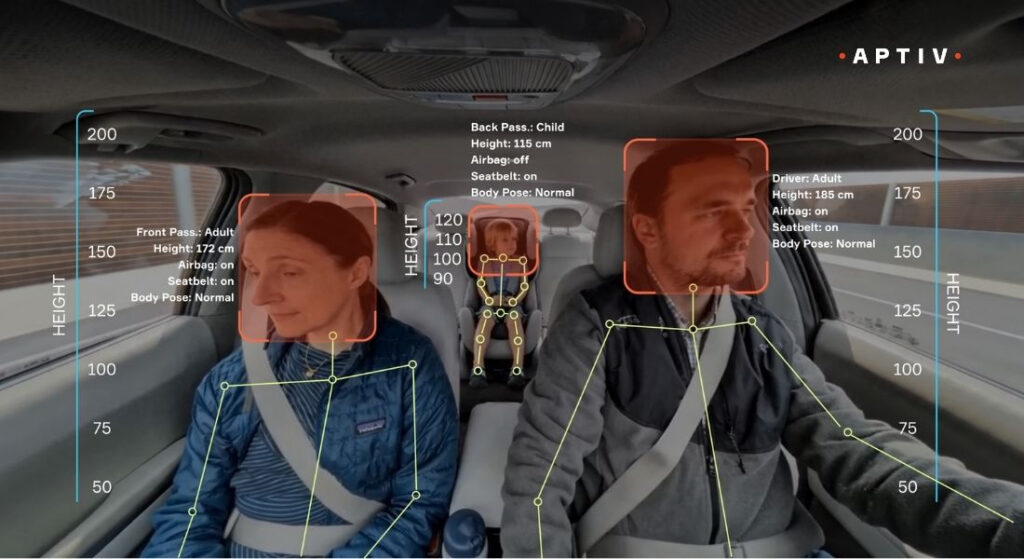
This high-performance logic fusion analyzes real-time visual data to accurately classify occupants based on critical parameters. The system instantly evaluates height, estimated weight, body position, posture, and spatial orientation. It reliably distinguishes between adult passengers, children, infants secured in rear-facing carriers, and inanimate objects placed on the seats.
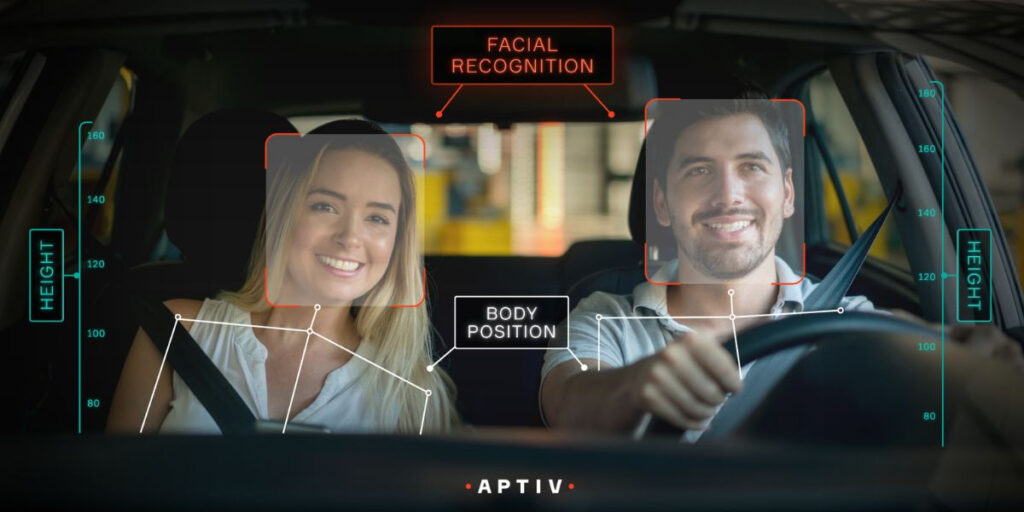
For engineering teams, this means the software can interpret complex spatial dynamics within the cabin without requiring localized seat sensors. It provides a robust, highly stable data stream that directly interfaces with the vehicle’s central compute and safety domain controllers.
Optimizing Airbag Deployment and FMVSS 208 Compliance
Safety compliance remains the highest priority for any automotive component. The Aptiv Advanced Occupancy Classification system has achieved a flawless 100% accuracy rating across stringent federal regulatory tests. This includes rigorous evaluations under the FMVSS 208 regulation, which dictates how vehicles must protect occupants during frontal crashes.
By feeding real-time, high-fidelity visual data into the vehicle’s safety algorithms, the system optimizes airbag deployment decisions. If a small child, an infant carrier, or an out-of-position passenger is detected, the system can instantly signal the airbag module to suppress deployment entirely or dynamically adjust the inflation force and timing. This granular level of control significantly reduces the risk of deployment-related injuries, providing a tailored safety response that static pressure sensors simply cannot match.
Streamlining Vehicle Architecture: Up to 40% BOM Reduction
The economic and architectural advantages of the Aptiv Advanced Occupancy Classification system are profound. By stripping out physical in-seat sensors, associated wiring harnesses, and localized microcontrollers, the system fundamentally simplifies the cabin’s electronic architecture.
A single, strategically placed interior camera assumes the workload of multiple decentralized hardware components. According to Aptiv, this consolidation can lower the bill-of-materials (BOM) cost by up to 40%. Beyond direct cost savings, removing in-seat hardware translates to significant reductions in assembly time and complexity on the manufacturing floor.
Furthermore, this hardware-lean approach offers automotive designers unprecedented physical flexibility. Without the constraints of embedded sensor mats, engineers can design thinner, lighter seat profiles. This facilitates the easier integration of premium comfort features—such as active heating, ventilation, and pneumatic massage systems—without compromising the integrity of the safety systems.
Unlocking Smart-Cabin Intelligence via Software
The true value of a software-defined architecture lies in its scalability. The same interior camera utilized by the Aptiv Advanced Occupancy Classification system can be leveraged to deploy more than 15 distinct safety and comfort functionalities. Because the processing logic resides in the software layer, OEMs can multiplex the sensor’s utility.
Supported multiplexed functions include:
- Real-time seatbelt-status monitoring and enforcement.
- Advanced driver-attention and drowsiness tracking.
- Intuitive gesture recognition for infotainment control.
- Comprehensive body-pose analysis for active ergonomics.
- Hands-on-wheel detection for Level 2+ and Level 3 autonomous driving systems.
This multi-faceted capability transforms a single optical sensor into a foundational node for complete smart-cabin intelligence.
Future-Proofing the Fleet with Over-the-Air (OTA) Updates
In the era of the Software-Defined Vehicle, hardware longevity is dictated by software adaptability. Aptiv’s solution is designed from the ground up to be fully upgradable over-the-air (OTA). As global safety regulations evolve and new NCAP (New Car Assessment Program) requirements are introduced, OEMs can push algorithmic updates directly to the vehicle fleet.
This OTA capability ensures that the Aptiv Advanced Occupancy Classification system remains a future-resilient solution. It eliminates the need for costly hardware recalls or mid-cycle redesigns to meet shifting compliance standards. Automakers can continuously refine classification models, introduce new safety features, and extend the hardware lifecycle over the vehicle’s lifespan—all without adding a single physical sensor.
Showcasing the Future of In-Cabin Technology
Aptiv’s commitment to advancing industrial technology and automotive infrastructure will be on display at the upcoming InCabin USA event at Huntington Place in Detroit. The live vehicle demonstration will not only feature the Advanced Occupancy Classification system but also highlight the broader ecosystem of driver monitoring, the Cockpit Sound Suite, and robust Android Automotive Framework integrations. For B2B technology stakeholders, this represents a crucial look at the scalable, software-centric future of automotive design.
Get the latest updates only on aarokatech.com